Guides / Compliance
Food Contact Materials Compliance for Goods Made in Vietnam
October 25, 2026
If your product touches food, a good-looking sample is not enough. Pots, bowls, lunch boxes, cutting boards, bottles, baby products and food packaging all fall under rules that limit what can move from the material into the food. Those rules differ by market, and a test report that satisfies one buyer may not satisfy another.
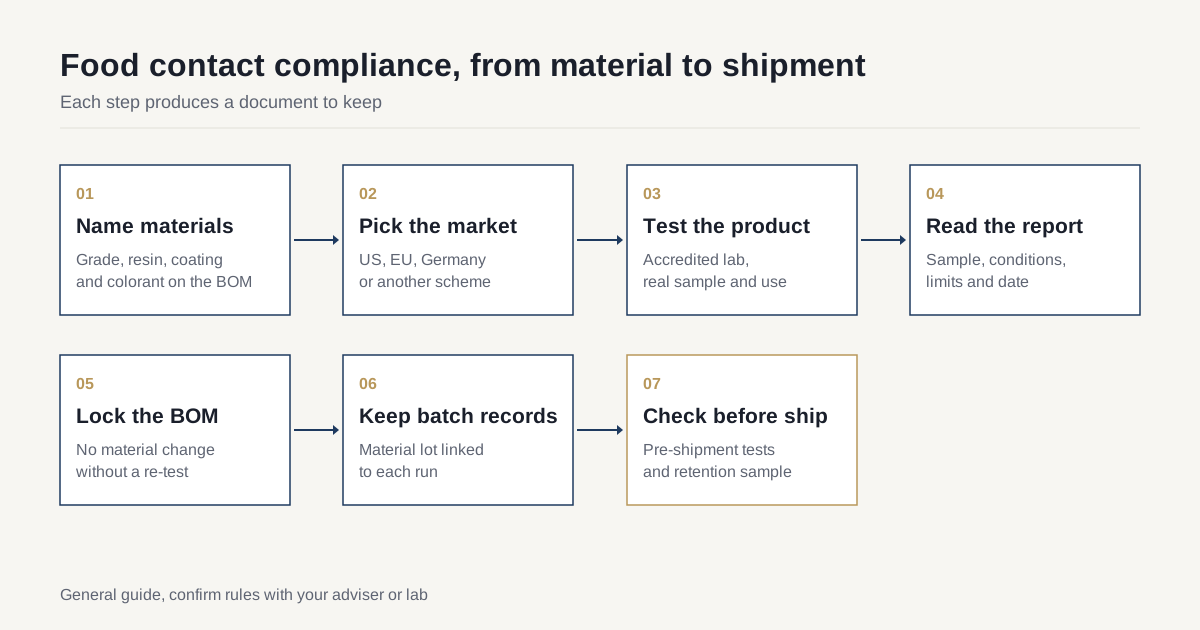
This guide explains the main schemes, which tests buyers ask for, what the factory can arrange in Vietnam and what to check before you pay for a shipment. It is general information, not legal advice. Confirm current rules with your compliance adviser or the lab.
What “food contact compliant” means
A food contact material is any material meant to touch food during preparation, storage, serving or eating. Compliance means two things.
- The material is allowed. The raw material, such as a plastic resin, a stainless steel grade, a coating or a silicone, is made of substances the market permits for food contact.
- The finished product behaves. When the product touches food under normal use, it does not release substances above set limits and does not change the taste or smell of the food.
The first point is about the material supplier. The second is about the finished item, including colours, inks, adhesives and coatings added during manufacturing. A compliant resin can still make a non-compliant product if the colorant or the process is not right.
The main schemes buyers ask for
United States. Food contact materials are regulated through the federal law on food, drugs and cosmetics and the rules in Title 21 of the Code of Federal Regulations. Plastics, for example, are covered in Part 177. Compliance is shown by using permitted materials and, in practice, by a lab report. The FDA does not certify products.
European Union. Regulation (EC) No 1935/2004 is the framework for all food contact materials. Specific measures apply to some materials, such as plastics under Regulation (EU) No 10/2011. Sellers must be able to show a declaration of compliance and supporting data. Testing for migration is done with food simulants.
Germany, the LFGB. The German Food and Feed Code adds requirements, and its section 30 is widely cited for testing. LFGB reports often cover migration and a sensory check of smell and taste, which is why some buyers prefer them for silicone and plastic goods.
Other markets. Japan, South Korea, Canada and others have their own lists and limits. A buyer shipping to several markets should name each one in the brief.
Do not assume that one scheme covers another. Ask your buyer or adviser which report their customer will accept.
What gets tested
The tests depend on the material.
| Material | Typical food contact checks | Notes, confirm with the lab |
|---|---|---|
| Stainless steel | Metal release into food simulants, such as chromium and nickel | Grade matters, so state it on the brief |
| Plastics (PP, PE, PET) | Overall migration, specific migration of named substances | Colorants and additives are included |
| Melamine and phenolic | Formaldehyde and melamine migration | Check current limits for your market |
| Silicone | Migration, volatile content | Smell and taste checks are common |
| Ceramic and glass | Lead and cadmium release | Glazes and decoration matter |
| Wood and bamboo items | Finish and coating migration, and in some cases adhesive | Check how the finish is described |
| Paper and board packaging | Migration, plus coatings and inks | Barrier layers may need their own tests |
| Coatings on cookware | Migration and heavy metal release | Coating supplier data helps |
The lab chooses the exact tests from the product and the target market. Give the lab the material list and the intended use, such as hot liquids or acidic food, because those change the conditions.
What a factory in Vietnam can do
Most factories that make kitchenware or packaging for export are used to the question. A good one will:
- Name the material, grade and supplier of each food contact part.
- Hold the material supplier’s own declaration or test data.
- Send samples to an independent laboratory on request and pass back the report.
- Keep records of which batch of material went into which production run.
Ask whether the lab holds ISO/IEC 17025 accreditation for the tests in the report, since that standard covers lab competence. A report is about the sample tested, so it does not turn a factory into a certified facility. Do not describe a factory as “FDA approved” or “LFGB certified” unless a report or document clearly says so and covers your product.
How to read a test report
Reports are short, and most of the useful information is on the first page.
- Sample description. Does it match your product, material and colour? A report on a white sample does not cover a red one.
- Test conditions. Temperature, duration and simulant must fit actual use. A cold-water test does not clear a product used for hot soup.
- Limits and results. Results should sit below the limit, with the limit shown.
- Standard and date. Check that the regulation named is current. Reports go out of date when rules change.
- Lab and signature. The lab name, address and report number should be traceable.
If anything is unclear, ask the lab or your adviser before you ship.
Keeping compliance when production starts
A report on the first sample does not protect you if materials change later.
- Fix the food contact material, grade, supplier and colorant in the signed bill of materials. See bill of materials for a turnkey order.
- Treat any change of resin, colour, coating or supplier as a trigger for new testing. The process in engineering change orders mid-production fits here.
- Keep a retention sample from each batch.
- Ask for a batch record that links the finished goods to the material lot.
- Include the test in your pre-shipment checks, as described in pre-shipment product testing.
Common mistakes
Buying on a generic certificate. A document listing a material in general says little about your finished product. Ask for a report on the product.
Testing one colour and selling five. Colorants can change migration. Test each colour family or ask the lab what is needed.
Forgetting the packaging. Inner bags, sleeves and printed film may touch the food or sit close to it. Include them.
Assuming the factory knows your market. Say where the product will be sold, in writing, on the first brief.
Marketing claims that go further than the report. Phrases such as “non-toxic” or “BPA free” are claims you must support. Use only those your reports cover.
Special cases to plan for
Baby and children’s products. Items for infants and small children, such as feeding bottles, teething items and tableware, often face stricter rules and stricter retailers. Ask your adviser whether extra limits apply to your product before you begin design.
Silicone. Silicone is popular for baking tools and lids. Quality differs widely between grades. Ask for the grade, the cure method and migration data, and run a smell test on a heated sample.
Wood and bamboo. Natural materials vary from piece to piece. The finish and any glue are the main food contact questions. Do not describe a finish as food safe unless the supplier’s data or a test supports the claim.
Recycled content. Recycled plastic in food contact has its own rules in many markets, because the recycling process has to remove contaminants. See recycled and bio-based materials before you ask for it.
Printed and decorated items. Inks, decals and glazes can contact food or lips. Name the decoration method and test the decorated area.
Multi-material products. A set with a steel pot, a plastic handle and a silicone lid has three materials to document. Treat each as a separate line with its own supplier data.
A short food contact brief
State these points and a factory can quote including the right tests:
- The product, its intended use and the foods and temperatures it meets.
- Materials and grades for each food contact part.
- Destination markets and the scheme each requires.
- Whether you want testing by the factory’s lab or by an independent lab you name.
- Who pays for first tests and for re-tests after a change.
- The marking you need on the product and packaging.
If you want to compare factories on these points, send your brief and we will introduce up to three Vietnamese manufacturers that make food contact goods at your volume. For the wider scope of what a factory covers, see what turnkey manufacturing includes.
Frequently asked questions
Is there an FDA certificate for kitchenware made in Vietnam?
No. The FDA does not approve or certify finished kitchenware. A product is compliant when its materials meet the relevant US rules and the importer can show it, usually with a test report from an accredited lab on the actual product. Be cautious of any supplier that offers an 'FDA certificate' without a lab report behind it.
What is LFGB testing?
LFGB is the German food and feed code. A LFGB test checks whether substances migrate from a food contact item into food or a food simulant at levels the German rules allow, and may also check smell and taste. Buyers in Germany and nearby markets often ask for it, and some ask for it for silicone and plastics because it is stricter than other schemes.
Who pays for food contact testing, the buyer or the factory?
It is negotiable and should be stated in the brief. Many factories include one round of standard tests in the price of a new product. Re-tests after a material change and tests to a market the factory was not told about usually fall to the buyer. Write the answer into the quote.
Ready to get this quoted?
Send the brief. We match you with up to 3 manufacturers in Vietnam that can carry your scope and reply within 24 business hours.
Get matched with a manufacturer