Guides / Compliance
During Production Inspection: The Check That Saves the Order
October 18, 2026
A final inspection tells you whether the goods in the cartons are acceptable. It does not tell you why, and it cannot undo what is already built. By the time the inspector opens the first carton, the order is finished, packed and often late.
A during production inspection, shortened to DUPRO, moves the check earlier. It looks at the line while it is running, when a wrong drilling position or a poor weld can still be fixed on the remaining units.
What the inspector looks at
The visit covers both the product and the process. A typical checklist includes:
- Finished units, drawn at random from the part of the order that is complete, checked against the approved sample and the specification.
- Work in progress, checked at several stages of the line.
- Materials in use, compared with the approved bill of materials. This is where a quiet substitution of resin, fabric or hardware shows up.
- Dimensions and function, measured with the right tools, for example calipers or a test fixture, on a sample.
- Workmanship, meaning appearance and finish compared with the golden sample.
- Packaging in preparation, including cartons, labels, barcodes and inserts, since a labelling mistake is cheaper to fix now.
- Process records, such as first article reports and any process control records the factory keeps.
- Production status, meaning how many units are done and whether the schedule is realistic.
The inspector reports with photos and measurements. You get a record of what was there, not an opinion.
Where DUPRO sits among the inspections
| Inspection | Typical timing | Main purpose |
|---|---|---|
| Pre-production check | Before production starts | Confirm materials, tooling and the factory’s readiness |
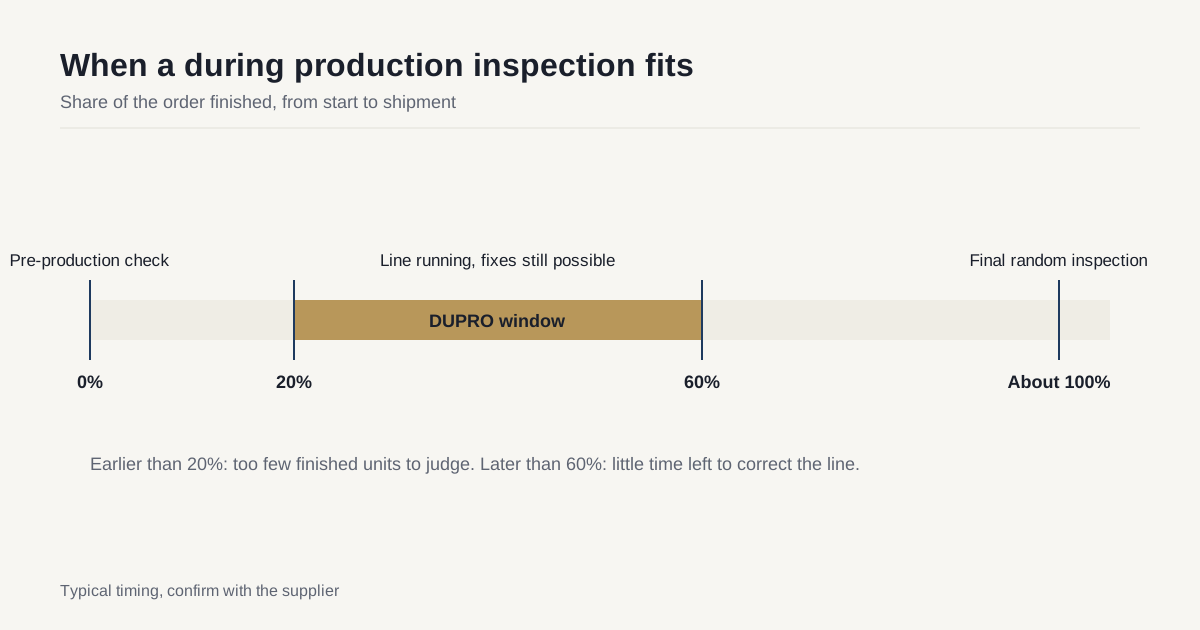
| During production inspection | Roughly one fifth to three fifths of the order done | Find defects while there is time to fix them |
| Final random inspection | When the order is complete and mostly packed | Decide whether the order can ship |
| Container loading check | At loading | Confirm quantity, condition and sealing |
Each of these answers a different question. Skipping the middle one is the common choice for small orders, and also the one buyers most often regret.
The sampling and acceptance rules for the final inspection are explained in AQL inspection levels explained.
What a DUPRO tends to catch
Experienced buyers see the same kinds of findings repeatedly.
- Systematic errors: a hole drilled in the wrong place on every unit, a label printed with the wrong text, a polarity mistake on a connector. These repeat on every unit until someone notices.
- Material substitution: a different grade of plastic, thinner fabric or cheaper fasteners than the approved sample.
- Process drift: a machine setting that has moved since the pilot run, causing sink marks, burrs or variation.
- Workmanship gaps: uneven finish, loose parts or glue marks from a line that was not trained on the golden sample.
- Schedule risk: units finished far below plan, which signals that the delivery date will slip.
Systematic errors matter most. If you find one at 30 percent, the factory can correct 70 percent of the order. If you find it at final inspection, the options are rework of everything or shipping with the error.
When to book it
Book the inspection when enough units are finished to give a fair sample and enough remain to be corrected. A common rule is when roughly 20 to 60 percent of the order is complete. For long orders you can run two, one early and one mid-way.
Tell the factory the planned window in advance and ask them to confirm that finished and in-progress units will be available. Do not give an exact date more than a few days ahead unless your contract allows it. The aim is to see normal production, not a prepared floor.
Book earlier for:
- A first order with a new factory.
- A complex product with several components.
- A factory with a record of substitution or late delivery.
- An order with a hard market deadline, such as a seasonal launch.
Plan against calendar events as well. Production around the lunar new year is especially risky and is covered in planning production around Tet in Vietnam.
Who should run it
You have three choices:
- Your own staff if you have someone with product knowledge nearby. It is the cheapest and gives you direct knowledge of the factory.
- A third-party inspection company, which offers trained inspectors and standard reports. Cost is typically charged per inspector per day, plus travel.
- A sourcing partner’s team, which can be efficient if they know the product.
Whoever you choose, give the inspector a checklist and the approved sample. An inspector without a clear reference reports what looks wrong to them, not what differs from what you agreed.
Writing the checklist
A good checklist is short and specific. Include:
- The approved sample or golden sample, with photos.
- The drawing, the specification and the bill of materials.
- Critical dimensions and the tool used to measure each.
- Functional checks, in the order they are done.
- Cosmetic standards with photos of acceptable and unacceptable examples.
- Packaging and labelling requirements.
- The sample size and the defect limits you accept.
Defects are usually classed as critical, major or minor, with the same rules as a final inspection. Agree the classes before the visit so the report does not become a debate.
Using the result
The report is useful only if someone acts on it. When the inspector finds a problem:
- Ask the factory for a written corrective action within an agreed time, for example a few working days.
- Fix the cause, not only the units found. A re-sorting of finished units does not stop the next hundred having the same defect.
- Decide what to do with units already built: rework, scrap or accept with a deviation.
- Plan a follow-up check on the corrected line, either by the same inspector or by photo evidence.
- Record the finding for the next order.
If the report shows a serious process problem, consider pausing the shipment date. A shipment delayed by a week is cheaper than a shipment returned.
What DUPRO does not do
A DUPRO is a sample. It reduces risk and does not remove it. It does not replace the final inspection, and it does not test a product against safety standards, which belong to laboratory work covered in pre-shipment product testing.
It also depends on honesty on both sides. A factory that hides stock or arranges a show line defeats the point. Work with factories that welcome inspection and treat a finding as information. The factory-side habits behind that are covered in factory visit: what to check.
Cost and what it saves
Inspection companies usually charge by the inspector per day, plus travel, and the price depends on the company and the location. A DUPRO on a small order is typically one inspector for one day. Compare that cost with the cost of reworking a finished order, or of a delayed shipment, and it is easy to justify on a first order.
On repeat orders from a supplier with a clean record you may drop it and rely on the final inspection. Keep the option open in the contract so that a problem order can be checked again.
A short checklist
- Decide whether the order’s risk justifies a DUPRO.
- Pick the window, at roughly one fifth to three fifths complete.
- Give the inspector the sample, drawings, checklist and defect limits.
- Ask for photos and measurements in the report.
- Require a written corrective action for any finding.
- Plan the final inspection around the corrected line.
If you want a second pair of eyes on your first order, send your brief and mention the inspections you expect. We match you with up to three Vietnamese manufacturers that accept inspection while the line is running.
Frequently asked questions
When should a during production inspection take place?
Most buyers book it when roughly 20 to 60 percent of the order is finished. Earlier gives too few finished goods to judge. Later leaves too little time to correct the line. The inspector needs both finished units and units still in progress.
How is it different from a final inspection?
A final inspection checks a sample from a finished and packed order and decides whether to ship. A during production inspection checks work in progress while the line is still running, so a defect can be fixed before it is built into the whole order.
Do I need one for every order?
Not always. First orders, orders from a new factory, complex products and tight deadlines justify it. A repeat order from a supplier with a clean record may only need a final inspection. Decide by the risk and by what a late discovery would cost you.
Ready to get this quoted?
Send the brief. We match you with up to 3 manufacturers in Vietnam that can carry your scope and reply within 24 business hours.
Get matched with a manufacturer