Guides / Cost
Bill of Materials for a Turnkey Order: How to Read the Cost Line by Line
October 10, 2026
Two quotes for the same product can differ by thirty percent and both be honest. The difference is usually in the bill of materials: one factory priced a stainless fastener where the other priced zinc plated, one counted a polybag and the other did not. If you can read the BOM, you can see this in an afternoon. If you cannot, you are comparing totals and guessing.
This guide explains what a bill of materials holds, how a turnkey price usually splits and what to check before you accept a number.
What a bill of materials contains
A BOM lists everything needed to make one finished unit. A usable one has these columns for every line.
- Item number and a plain description.
- Specification: material, grade, size, finish, colour, standard.
- Quantity per unit, including multiples such as four screws per unit.
- Supplier or source, or at least local versus imported.
- Unit cost in the quote currency.
- Scrap or waste allowance, since cutting, molding and machining lose material.
- Notes, such as “customer approved brand” or “alternate allowed”.
A BOM with only a description and a total is a parts list, not a cost tool. Ask for the columns above.
How a turnkey price splits
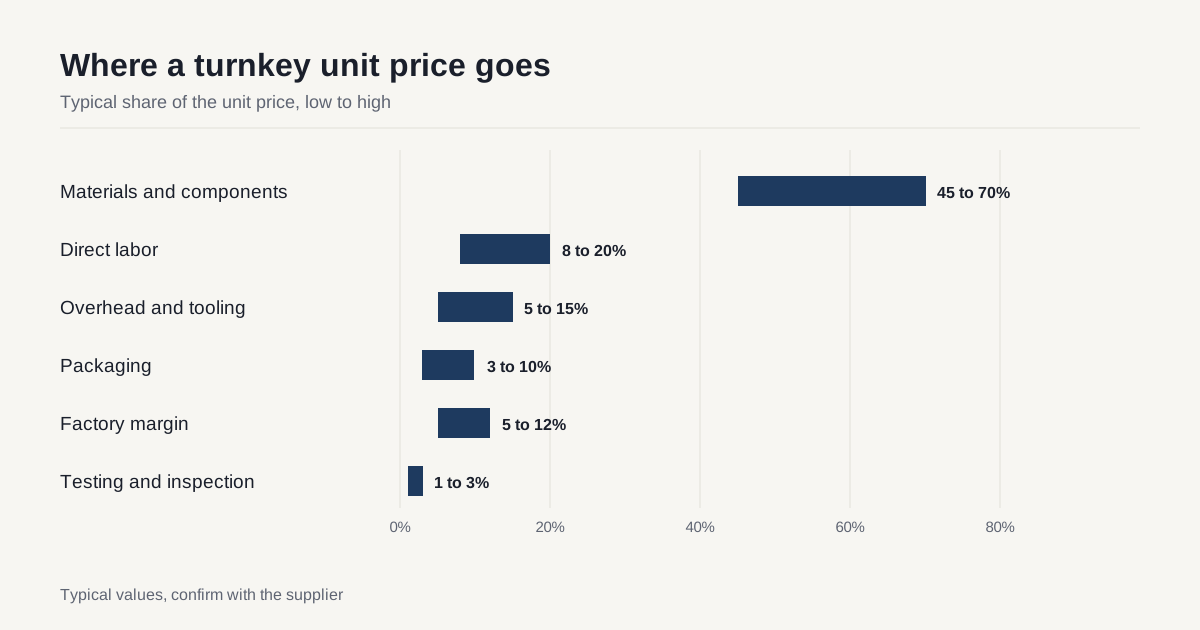
On a turnkey order the unit price covers more than parts. A typical split for a manufactured consumer product looks like the table below. The shares vary widely by product, so read them as a shape and not as a promise.
| Cost block | Typical share of unit price, confirm per quote | What it covers |
|---|---|---|
| Materials and components | 45 to 70% | Everything on the BOM, with waste |
| Direct labor | 8 to 20% | Forming, sewing, assembly, finishing |
| Overhead and tooling amortization | 5 to 15% | Energy, equipment time, mold or jig cost spread over units |
| Packaging | 3 to 10% | Inner pack, carton, labels, inserts |
| Testing and inspection | 1 to 3% | In-house checks, sample testing |
| Factory margin | 5 to 12% | Profit and risk allowance |
Electronics and appliances sit at the high end for materials. Hand-sewn and hand-finished goods sit higher on labor. If a quote shows materials at 30% for a mass-produced plastic product, ask what else is in there.
Reading the BOM line by line
Start with the five largest lines by cost. They usually account for the majority of the material cost, so errors there matter most.
Check the specification first. Is the material the one you asked for? A product brief that says “stainless steel” and a BOM that says “201 stainless” are two different products. Say which grade you expect.
Check quantity and waste. Compare the quantity per unit to the drawing. Then look at the waste allowance. Five to ten percent is common for cut or molded materials, and an allowance far above that needs an explanation.
Check the source. Imported parts carry shipping, duty and a longer wait. A BOM that is fully local can be quicker but may use lower grade material. See raw material sourcing in Vietnam for the local versus imported question.
Check the unit cost against a second source. If you can, ask for the price of the same part from another supplier or check a public listing for a comparable item. You are looking for outliers, not for a lower price on every line.
Check the small lines. Screws, tape, labels, polybags and silica gel add up. A quote that omits them has not finished the pricing.
Where cost hides in a turnkey quote
Buying margin on parts. Factories often add a handling margin to parts they buy for you. This is normal, and a reasonable margin buys you someone who carries the risk of shortages. Ask what it is.
Scrap and rework. First orders waste more. Some factories price a higher allowance for the first run and lower it after.
Tooling amortization. If the factory spreads mold cost across units, the unit price drops when the tool is paid off. Agree this in writing. Who owns the tooling explains why.
Packaging detail. A printed carton with a custom insert can cost more than the product’s plastic parts. Price it as its own block.
Testing. If you need lab tests or third party inspection, they may sit outside the unit price. Ask where.
Using the BOM to compare quotes
Put two BOMs side by side, one line per row.
- Match the lines by function. A different name for the same part is common.
- Mark any line that is on one BOM only.
- Compare specification, not just price. A cheaper line with a lower grade is not cheaper.
- Compare the total material cost and the total non-material cost separately. A low material cost with a high margin hides the same price.
- Ask each factory to explain the three biggest differences in writing.
You will often find that one quote is simply more complete. A complete quote that is higher can be the safer buy. See turnkey manufacturing cost in Vietnam for what each block of cost normally includes.
Locking the BOM
Once you pick a factory, lock the BOM before the pilot run.
- Sign off the specification of every line that affects look, feel or safety.
- List approved alternates for lines with a long lead time, so a shortage does not stop the line.
- Fix the brands of critical parts such as motors, switches, zippers and food-contact materials.
- Agree how changes are made. A change in material, supplier or finish goes through a written change with the cost effect stated, as described in engineering change orders mid-production.
- Keep a copy of the signed BOM with the golden sample.
Common mistakes
Accepting a total without the BOM. You cannot tell what you are buying or what changed when the price moves.
Not fixing critical brands. A factory may swap a part for a cheaper one. A named part or an approved list prevents it.
Forgetting freight on imported parts. The BOM may show the part cost but not inbound shipping and duty. Ask whether they are in the unit price.
Letting the BOM drift. Over several orders small substitutions accumulate. Compare the live BOM to the signed one at each reorder.
A worked example with illustrative numbers
The figures below are invented to show how to read a BOM. They do not describe a real product.
| Line | Quantity per unit | Unit cost (USD) | Line cost (USD) |
|---|---|---|---|
| Molded housing, two halves | 1 set | 1.40 | 1.40 |
| Stainless steel part | 1 | 1.10 | 1.10 |
| Fasteners and small hardware | 8 | 0.02 | 0.16 |
| Seal or gasket | 1 | 0.12 | 0.12 |
| Label and insert | 1 | 0.08 | 0.08 |
| Waste allowance, 6% of the above | 0.17 | ||
| Materials total | 3.03 |
Say the quote shows a unit price of 6.00 USD. Materials are then about half of the price, which sits inside the usual range. Labor, overhead, packaging, testing and margin make up the rest. Now ask three questions. Is the waste allowance reasonable for a molded part? Is the stainless steel line priced on the grade you named? Where is the packaging, which is not on this BOM at all? A BOM that leaves out the carton and inner pack is not complete, and the missing cost will appear later as an extra.
Revision control
A BOM changes during development. Give each version a number and a date, and keep the factory’s copy and yours in step. When a quote and a later invoice differ, the version number tells you which BOM each one used. Ask the factory to flag every change between versions, with the reason, so you can approve or reject it before material is bought.
A short BOM request
Ask the factory for:
- A BOM with item, specification, quantity, source, unit cost and waste allowance on each line.
- A split of the unit price into materials, labor, overhead, packaging, testing and margin.
- The lead time and minimum quantity of the five longest lead lines.
- A list of any part that the factory proposes to replace with an equivalent.
If you want help comparing quotes, send your brief and the manufacturers we introduce will price from the same specification, so their BOMs can be compared line by line.
Frequently asked questions
What is a bill of materials in manufacturing?
A bill of materials, or BOM, is the list of every part and material that goes into one finished unit, with quantity, specification, supplier and unit cost for each line. On a turnkey order the factory builds it, prices it and shares it with you so the quote can be checked.
Should I ask the factory to show the BOM?
Yes. A BOM with a cost on each line is the best way to compare two quotes and to see where a price change comes from. Some factories share it only after you commit to a sample. Ask for it at the quote stage and say you will keep it confidential.
Can I change a part after the BOM is agreed?
You can, through a written engineering change that states the new part, the cost change and the effect on lead time. Changes after tooling or material purchase usually cost more, which is why the BOM should be reviewed line by line before the pilot run.
Ready to get this quoted?
Send the brief. We match you with up to 3 manufacturers in Vietnam that can carry your scope and reply within 24 business hours.
Get matched with a manufacturer