Guides / Process
How to Run an Engineering Change Order While Production Is Running
October 22, 2026
No product leaves the factory exactly as the first drawing described it. A supplier proposes a cheaper part. A test shows a weak joint. A customer asks for another colour. The question is not whether the design will change after production starts, but whether the change is handled in writing or in chat messages that nobody can find later.
An engineering change order, usually shortened to ECO, is the tool for the job. This guide shows how to run one so that stock, price and schedule stay under control.
What an ECO records
A useful ECO is one page and answers six questions.
- What changes. The part number, the old specification and the new one, ideally with a marked-up drawing.
- Why. A quality problem, a cost saving, a supply issue or a customer request.
- What it touches. Tooling, bill of materials, assembly, packaging, labels, test method and certificates.
- What it costs. One-off costs such as tool modification and any change in unit price.
- When it starts. The point from which new production uses the change, called the effective point.
- What happens to old stock. Use as is, rework or scrap.
A change without those six answers will cause an argument later. Writing them forces both sides to see the whole effect before they agree.
Who can ask for a change
Both sides can, and the process should work either way.
- Buyer-initiated: design improvement, new colour, new component or a change in market rules.
- Supplier-initiated: a cheaper material, a shortage of a part or a process improvement.
Supplier-initiated changes need the strictest rule. Do not allow a supplier to change a material, a component or a process without written approval, even when the change looks equal. A supplier who swaps a plastic grade or a screw type to save a little may alter strength, finish or compliance in ways that surface after shipment. Put the rule in the contract: no change without a signed ECO.
Sorting changes by size
Not every change needs the same weight of process. A simple scale helps.
| Change | Example | Typical impact | Approval needed |
|---|---|---|---|
| Minor | Label wording, carton print, barcode | Packaging stock only | Buyer sign-off |
| Moderate | Colour, finish, supplier of a standard component | Samples, possibly tests | Buyer sign-off plus a new sample |
| Major | Dimension, material, wall thickness, electronic component | Tooling, tests, certificates | Buyer sign-off, new sample, retest |
| Tool change | New cavity, added feature, revised gate | Tool downtime and trial shots | Buyer sign-off, first article, retest |
Whatever scale you use, apply the same rule: anything that changes form, fit or function counts as major, and may need new approvals from your market.
Tooling changes: adding steel is easier than removing it
When a change touches a mold or die, a basic fact of toolmaking applies. Removing steel from a mold, for example making a feature bigger or a wall thinner, is relatively straightforward. Adding steel, for example making a feature smaller or a wall thicker, needs welding or an insert, and the result can be less durable or leave marks.
Ask the toolmaker which direction your change goes. Where possible, design the original tool so that likely changes remove steel rather than add it. This is called making the mold steel-safe, and it is a request worth making before the tool is cut. Cost and lead time for modifications are included in the thinking in what to budget for injection mold tooling in Vietnam.
Tool changes also take the tool off the production line. Ask how long the press or die cast machine will be idle and where the production runs in the meantime.
What to do about stock and work in progress
Every ECO leaves behind material built to the old design. Decide on it before the change takes effect.
- Finished goods. Ship if the change does not affect safety or compliance, or hold for rework.
- Work in progress. Finish to the old design, rework or scrap, depending on how far along it is.
- Raw material and bought-in parts. Use up, return to the supplier or scrap.
- Packaging. Printed packaging with old text is a common leftover. Decide whether to sticker over, reprint or use up.
State who bears each cost. Where the buyer asked for the change, the buyer usually pays for obsolete stock, and the factory should give a quantity count so the number is real. Where the supplier asked, the supplier usually pays. Where a change corrects a defect that the factory introduced, the factory pays.
Cut-in points
The effective point tells everyone when the new version starts. Common choices:
- By date: from a calendar date forward.
- By lot or batch: from the next production lot.
- By serial number: from a defined unit number. This is the most accurate and makes traceability easier.
- After stock runs out: use up old materials first, then start the new version.
For anything that affects safety or fit, avoid mixing old and new in one shipment unless the parts are interchangeable. If mixing is unavoidable, mark the cartons so the receiver can tell which version is which.
Records and revision control
The factory and the buyer should both hold the same revision of each drawing and bill of materials. Give each revision a letter or number and put it on the drawing, the bill and the ECO.
Keep a log showing each ECO, its date, its status and the effective point. When a defect appears in the field, the log tells you which version the unit was.
Update the pilot sample reference, the test plan and the inspection checklist whenever an ECO changes them. Inspectors who check against an old drawing report problems that do not exist and miss problems that do. See the golden sample and pilot run for how a sample serves as the benchmark and when it needs replacing.
Approvals that may need repeating
A change can quietly invalidate an earlier approval. Consider each one:
- Product test reports, for example drop or safety tests, as discussed in pre-shipment product testing.
- Compliance certificates, which are tied to a specific design and material.
- Customer approvals, for retailers or brands that require sign-off on any change.
- Packaging artwork and barcode registrations.
If the change is minor, a short statement that it does not affect the report may be enough. If it is major, retest.
A simple ECO workflow
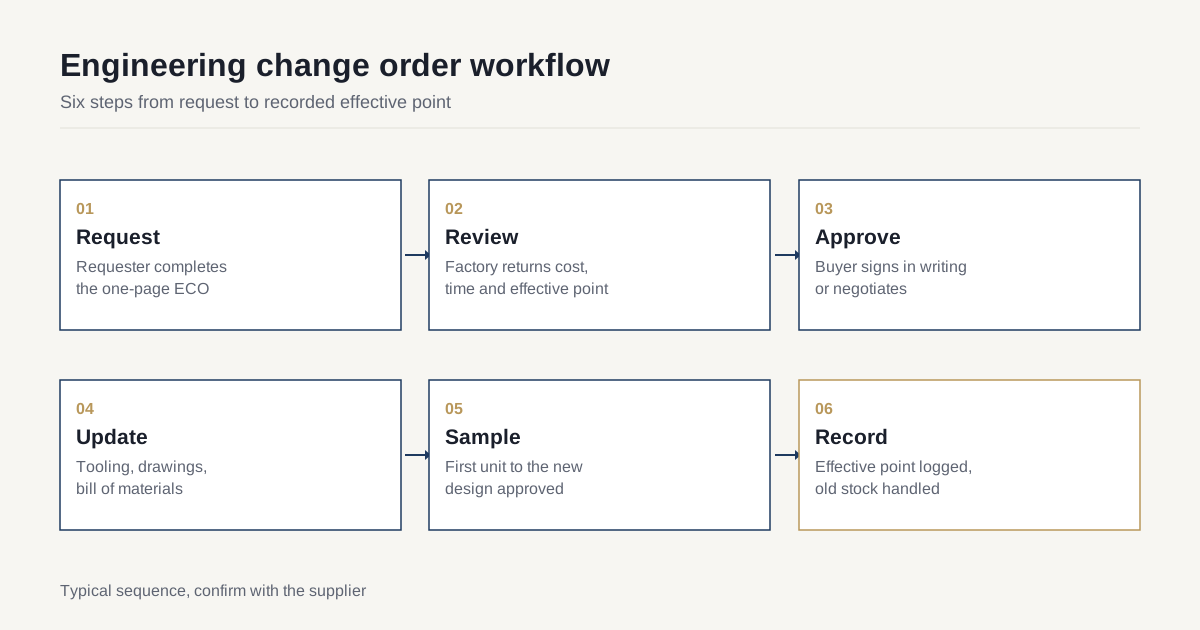
- The requester fills the ECO form with the six answers above.
- The factory reviews and returns the cost, the lead time and the effective point within an agreed time. Many buyers write this into the contract, for example a reply in a few working days.
- The buyer approves in writing, or negotiates.
- The factory updates tooling, drawings, bill of materials and work instructions.
- A sample made to the change is approved before volume production uses it.
- The effective point is recorded and old stock is handled as agreed.
Keep each step short. A change that sits in an email chain for three weeks can cost a shipment.
Pricing the change
Ask the factory to price each ECO in lines, not as one number. The lines to expect are tool modification, new samples, retesting, obsolete stock, any change in unit price and the time lost on the line. A single total makes it hard to see what you are paying for and impossible to compare against a second quote.
Also ask how long the change will take, from approval to the first unit made to the new design. Put that time in the ECO, since a change that takes six weeks may collide with a shipment you promised for four.
Before you request a change
- Write the change on a marked-up drawing, not only in words.
- Ask the factory what it touches and what it costs before you commit.
- Decide who pays for old stock and tool work.
- Set the effective point.
- Plan which tests, samples and certificates must be repeated.
- Update the drawings and checklists on both sides.
If your product is likely to change during its first year, say so when you send your brief, and we will match you with up to three Vietnamese manufacturers that handle written change control. How a clause on ownership interacts with changes is covered in who owns the tooling.
Frequently asked questions
What is an engineering change order?
It is a written instruction to change something about a product that is already approved: a dimension, a material, a component, a finish or a packaging detail. It records what changes, why, when it starts and who pays. Without one, a change is a verbal request and nobody owns the result.
Who pays for a change after tooling is made?
It depends on who asked and whether the change corrects a factory error or a design decision. A buyer-requested change usually carries the cost of modifying the tool, scrapping affected stock and the lost time. Agree the rule in the contract before the first change comes up.
Can I change a design after the pilot run is approved?
Yes, but each change reopens risk. Approved samples, tests and certificates may no longer match the product. Treat every change as small as a label colour or as large as a new tool and decide which approvals need to be repeated.
Ready to get this quoted?
Send the brief. We match you with up to 3 manufacturers in Vietnam that can carry your scope and reply within 24 business hours.
Get matched with a manufacturer