Guides / Process
Die Casting in Vietnam: Choosing Between Aluminum and Zinc Parts
October 15, 2026
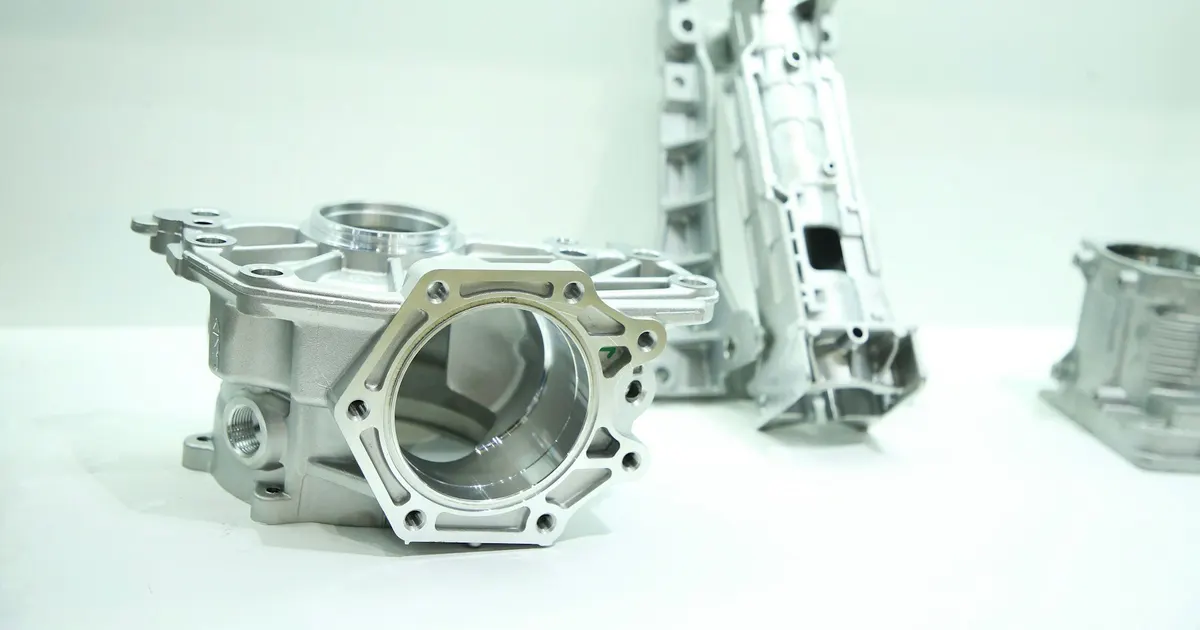
Die casting forces molten metal into a steel mold under pressure. It makes complex shapes with thin walls, ribs and bosses that would be slow and costly to machine, and it repeats them cycle after cycle. Housings, brackets, heat sinks, handles, gear boxes and decorative hardware are all made this way.
For a product buyer the choice is usually between aluminum and zinc. They behave differently in the mold and in the finished product, and the right pick depends on shape, weight, finish and volume.
How the process works
The mold has two halves made of hardened tool steel. They close, molten metal is injected, the metal solidifies in seconds and the halves open to eject the part. Each part leaves with a web of excess metal (gates, runners and overflows) that is trimmed off afterwards.
There are two machine types:
- Hot chamber machines keep the injection system in the molten metal. They are fast and suit metals with a lower melting point, such as zinc.
- Cold chamber machines ladle the metal into the injection chamber for each shot. They suit aluminum, which would attack the parts of a hot chamber machine.
You rarely need to choose the machine, but it explains why a factory that does zinc may not be the one that does aluminum.
Aluminum and zinc compared
| Property | Aluminum | Zinc |
|---|---|---|
| Weight | Light | Heavier, about two and a half times the density of aluminum |
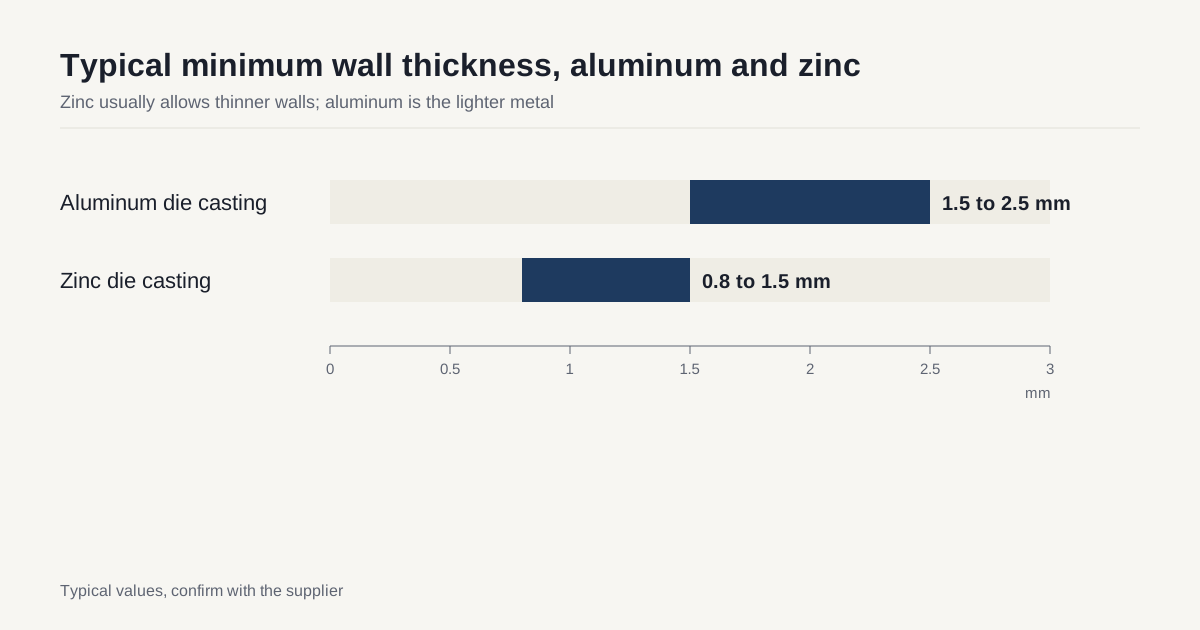
| Typical minimum wall | Around 1.5 to 2.5 mm | Down to about 0.8 to 1.5 mm |
| Tool life | Fewer shots before wear | Many more shots before wear |
| Detail and thin features | Good | Very good |
| Surface for plating | Harder to plate | Takes plating and coating well |
| Strength-to-weight | Higher | Lower |
| Typical products | Housings, frames, heat-dissipating parts | Small hardware, handles, locks, precision parts |
These are typical figures. Alloy, part geometry and the foundry’s process shift them, so confirm with the supplier.
Two common alloys show up on quotes. In Asia, aluminum parts are often cast in ADC12, a Japanese-standard alloy close to the US A383 alloy, and zinc parts are often cast in a Zamak alloy such as Zamak 3. Ask the foundry to name the alloy and the standard, and ask for the material certificate with the first shipment.
Tooling: what it costs and how long it lasts
Die casting tools are hardened steel and take weeks to make. Cost rises with part size, complexity and the number of slides that form side features. A simple small tool and a large multi-slide tool sit far apart in price, and the figure is typically in the tens of thousands of US dollars for products of moderate size. Treat any range as indicative and ask for a line-item quote.
Tool life is measured in shots. Zinc tools usually last much longer than aluminum tools because zinc is less aggressive on the steel. A tool for a product expected to sell a few thousand pieces a year will outlive the product. A tool for a very high volume part will need maintenance and perhaps a replacement. Ask the foundry what tool life they assume and what happens when the tool wears out.
As with plastic molds, ownership is a contract matter. Settle who owns the tooling before paying the deposit. The cost comparison with plastic molding is covered in what to budget for injection mold tooling in Vietnam.
Porosity, and why it matters
A die casting is rarely perfectly dense. Air trapped by the fast fill and shrinkage during cooling can leave small voids inside the wall. For many parts this is irrelevant. For some it is the main problem.
- Pressure-tight parts such as pump housings or valve bodies may leak through pores. They need a specified porosity limit and often impregnation, a sealing process, before use.
- Polished or plated parts can show pores on the surface after finishing as pits or blisters.
- Machined parts may reveal pores when a cut opens a void.
If porosity matters to your part, write the requirement into the brief and ask how the foundry will check for it, for example by sectioning samples or X-ray on a sample basis. If it does not matter, say that too, and the foundry will not over-engineer the process.
Trimming, machining and finishing
A casting leaves the press needing work.
- Trimming removes gates, runners and flash. Done by a trim press for volume and by hand for small runs.
- Deburring or tumbling smooths the edges.
- Machining finishes critical features: threads, bores, sealing faces and mounting surfaces. Castings are not accurate enough in these areas for most assemblies.
- Surface treatment protects and decorates the part.
Typical finishes by metal:
- Aluminum: powder coating, wet paint, chromate conversion coating and, with limits, anodizing.
- Zinc: plating (such as nickel or chrome), powder coating and paint.
Mark on the drawing which surfaces are cosmetic, which are machined and which must stay bare for grounding. Powder coating is common for both metals, and the practical rules for it are the same as on sheet metal parts, described in sheet metal fabrication in Vietnam.
Design rules that save money
A foundry’s engineer will review the design, and a few habits make that review short.
- Even walls. Thick sections trap gas and shrink. Core out thick areas and use ribs for stiffness.
- Draft. Walls need a small taper to release from the steel. Typical draft is one to three degrees depending on depth.
- Radii. Sharp internal corners concentrate stress and slow metal flow. Use generous radii.
- Minimal slides. Side features that need slides add tool cost. Redesign if you can.
- Machining allowance. Leave a small stock allowance on surfaces that will be machined.
These rules are close to the ones for plastic molding but with metal-specific limits, so do not assume a plastic design transfers to metal.
What the brief should say
For a quote that can be compared, give each foundry the same information:
- 3D file (STEP) and 2D drawing with critical dimensions and machined features marked.
- Metal and alloy preference, or the performance you need.
- Weight target if the part is held or carried.
- Porosity or pressure requirements, if any.
- Finish and cosmetic surfaces.
- Annual volume and first order quantity.
- Whether the foundry should also machine, finish and assemble.
Include the factory’s responsibility for the whole chain. A casting that goes to a separate machining shop and a separate coater adds handover risk, and a turnkey supplier takes that on. Minimums for cast parts are usually in the thousands, as discussed in minimum order quantity in Vietnam, by product type.
Lead time and trial shots
Making a die casting tool takes several weeks to a few months, depending on size and complexity. After that come the first trial shots, often called T1, which are rarely perfect. Expect corrections to the gating, cooling and trimming, followed by a second trial and then sample approval.
Ask for a schedule with those steps listed: tool design review, steel cutting, first trial, corrections, sample submission and approval. Production should not start until a sample has been measured against the drawing and approved in writing. A tool schedule that leaves out the trial and correction rounds is optimistic.
A first-order checklist
- Alloy named, with a material certificate promised.
- Tool cost, tool life assumption and ownership written down.
- Porosity requirement stated, with the inspection method.
- Machined and cosmetic surfaces marked on the drawing.
- Finish specified with a colour reference or plating spec.
- Trial and approval plan agreed before the volume run.
Send your brief with the drawing and we will match you with up to three Vietnamese manufacturers that cast, machine and finish parts of this type.
Frequently asked questions
When should I choose die casting over sheet metal or machining?
Die casting suits parts with complex shapes, thin walls and ribs that would be costly to machine, made in volumes that justify a steel tool. Sheet metal suits flat or folded shapes at low volume, and machining suits small runs or very tight tolerances. Compare total cost at your expected volume.
Why do some die cast parts leak or fail pressure tests?
Gas and shrinkage can leave tiny pores inside the casting, called porosity. It is normal to some degree. If your part must hold pressure or take a polished finish, tell the foundry in the brief so the gating, process and inspection are set up for it.
Can I anodize a die cast aluminum part?
You can, but the result is often less even and less attractive than on machined or extruded aluminum, because common die casting alloys contain silicon. If you need a decorative anodized look, ask for samples in your alloy first or consider powder coating instead.
Ready to get this quoted?
Send the brief. We match you with up to 3 manufacturers in Vietnam that can carry your scope and reply within 24 business hours.
Get matched with a manufacturer